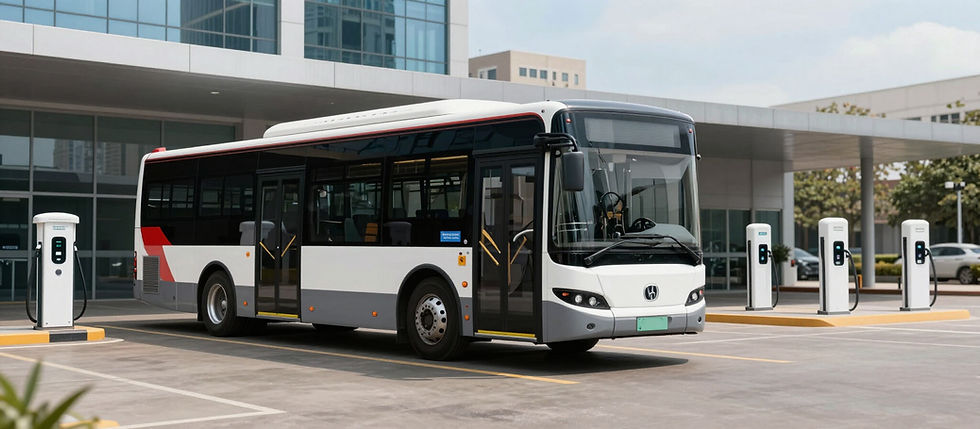
Electric mobility requires more than charge points.
Successful programmes depend on the relationship between vehicles, charging, routes, charging infrastructure, power supply, sites, operating schedules, digital platforms, and maintenance.
F315 helps clients bring these elements together within a practical implementation and operating plan.
Supporting the transport modes that matter most.
Electric buses and public transport
Route, fleet, depot, charging, energy, and operating planning for electric bus and public-transport programmes.
Commercial and government fleets
Fleet-transition planning, site assessment and charging infrastructure for high-utilisation fleets.
Electric two- and three-wheelers
Charging, battery-swapping, and operating models for motorcycles, taxis, delivery vehicles, and other high-volume urban transport.
Public and destination charging
Charging infrastructure for cities, highways, workplaces, developments, transport hubs, and public facilities.
Our electric mobility capabilities
Strategies, feasibility and roadmaps
Charging network planning
Fleet, depot and bus charging
National, city, and organisational plans covering transport demand, vehicle segments, infrastructure, energy, policy, phasing, and investment priorities.
Assessment of demand, suitable locations, charging types, network coverage, implementation phases and future expansion.
Charging strategies shaped around vehicle duty cycles, routes, timetables, depot operations, site constraints, and electrical capacity.
Public charging infrastructure
Site assessment, charger selection, user access, payments, accessibility, monitoring, and maintenance planning.
Power, solar and energy storage
Grid-capacity assessment, utility coordination, electrical upgrades, renewable-energy options, battery storage, resilience, and energy management.
Digital platforms and lifecycle support
Charge-point management, smart charging, fleet integration, payment interfaces, remote monitoring, fault management, maintenance, and network expansion.
Safety and technical requirements
Electrical protection, equipment suitability, site safety and emergency arrangements.
TECHNICAL ASSURANCE
Safe, interoperable and maintainable infrastructure.
Charging infrastructure must be designed around appropriate electrical, vehicle, communications and safety requirements.
F315 Mobility supports clients in defining technical requirements and coordinating the specialist inputs needed for compliant and reliable implementation.
Vehicle and charger compatibility
Connector types, charging performance, vehicle requirements and future fleet compatibility.
Open protocols and integration
Interoperability between chargers, management platforms, payment systems and authorised third-party services.
Operations and maintenance
Remote monitoring, fault response, spare parts, technician training and long-term support.
HOW WE DELIVER
Plan the transport operation first, then design charging around it.
01
Understand demand
Assess vehicles, routes, duty cycles, users, sites, energy demand, and operating constraints.
02
Develop the solution
Define vehicle, charging, power, digital, commercial, and operational requirements and prepare the implementation plan.
03
Pilot and implement
Validate assumptions, procure and deploy infrastructure, integrate systems, commission equipment, and prepare operations.
04
Operate and expand
Monitor performance, maintain assets, optimize charging and energy use, and expand the programme as demand grows.
Developing commercially realistic delivery models.
Electric mobility programmes may combine public funding, operator investment, utility participation, private charging providers and development finance. We help clients assess lifecycle costs, delivery options, responsibilities, risks and long-term operating requirements.
Public-sector programmes
Government or authority-led programmes supporting policy objectives, public fleets, bus services or wider charging-network development.
Charging as a service
A service model in which charging infrastructure and selected operational services are provided under an agreed commercial and performance arrangement.
Each model requires project-specific technical, commercial, financial and legal assessment.
Fleet and operator investment
Operator-funded vehicles and infrastructure supported by a clear assessment of fleet utilisation, energy costs, site requirements and operational benefits.
Public-private and blended-finance models
Structures combining public-sector objectives with private investment, utility participation or development-finance support.
Designed around transport and energy realities.
Electric mobility programmes must reflect local electricity availability, grid capacity, tariffs, site constraints, vehicle utilisation, climate, payment methods, maintenance capability and affordability.
We help clients select infrastructure and operating arrangements that can be supported locally, expanded over time and adapted as vehicles, energy systems and user demand evolve.
Grid and utility coordination
Resilient power options
Vehicle and route suitability
Local maintenance capability
User access and payment
Training and knowledge transfer
Develop an electric mobility programme built around real transport needs.
Speak with F315 Mobility about strategy, fleet charging, electric buses, public charging or energy integration.